|
|
Print
this page
Tests & Measurements: Parent Checklist
Understanding Your Child's Test Scores |
|
| Things to Do |
Not Yet |
Date Done |
| 1. Read this article - three times. Tests & Measurements for the Parent, Teacher, Attorney & Advocate. Print the article. Use your highlighter. https://www.wrightslaw.com/advoc/articles/tests_measurements.html |
| |
Notes/Comments:
|
| 2. Gather the names, dates, and scores of each test that has been administered to your child (including tests that have been administered more than once). |
|
|
Notes/Comments:
|
| 3. Make a list of all tests administered to your child. Arrange your list in chronological order. Begin your list with the tests that have been administered most frequently (i.e., WISC, WJ, WIAT, KTEA). |
| |
Notes/Comments:
|
| 4. Find the *standard scores or percentile rank scores in your child's file. |
| |
Notes/Comments:
|
| *5. If the standard scores are not available, ask the school for them. Request the data in standard score format. |
|
|
Notes/Comments:
|
| 6. First administration of a test battery: Write down all of the standard scores. |
| |
Notes/Comments:
|
7. Convert these first scores to percentile ranks. (See links in #13) |
| |
Notes/Comments:
|
| 8. Most recent testing of the same battery. Write down all of the standard scores. |
| |
Notes/Comments:
|
9. Convert these recent scores to percentile ranks. (See links in #13) |
|
|
Notes/Comments:
|
| 10. Compare the results of the first administration and the most recent testing. |
|
|
Notes/Comments:
|
| 11. Review the comparison of scores. Determine whether your child is being remediated (catching up), staying in the same position, or (regressing) falling further behind the peer group. |
|
|
Notes/Comments:
|
| 12. Chart out the test results. Show the greatest deficiencies where your child has shown minimal progress or regression. (Software programs like Excel and PowerPoint allow for dramatic visual presentations of data. If you do not have a computer, use graph paper.) https://www.wrightslaw.com/blog/graphing-evaluation-data-a-skill-all-parents-should-master/ |
|
|
Notes/Comments:
|
| 13. After steps 1-12 are completed, gather your material. — bell curve chart and standard score / percentile rank chart, list of test scores, and copies of your child's evaluations. |
|
|
Notes/Comments:
|
| 14. Consult with a private sector psychologist or educational diagnostician who can explain the significance of the scores using percentile ranks. Take your test data to the meeting. |
|
|
Notes/Comments:
|
| 15. Ask the professional to use the bell curve chart that includes standard scores, standard deviations and percentile ranks. (If possible, it may be helpful to tape record the session so you can review test results at home.) |
|
|
Notes/Comments:
|
Wrightslaw: Special Education Law, 2nd Edition:
- 20 U.S.C. Section 1414, Evaluations, page 92.
- 34 CFR 300.300, Evaluations, page 238.
Contact your state's Department of Education and request all publications about special education and IEPs, along with your state regulations. Find your State ED on the Wrightslaw Yellow Pages for Kids. http://www.yellowpagesforkids.com/help/seas.htm
Understanding Your Child's Test Scores
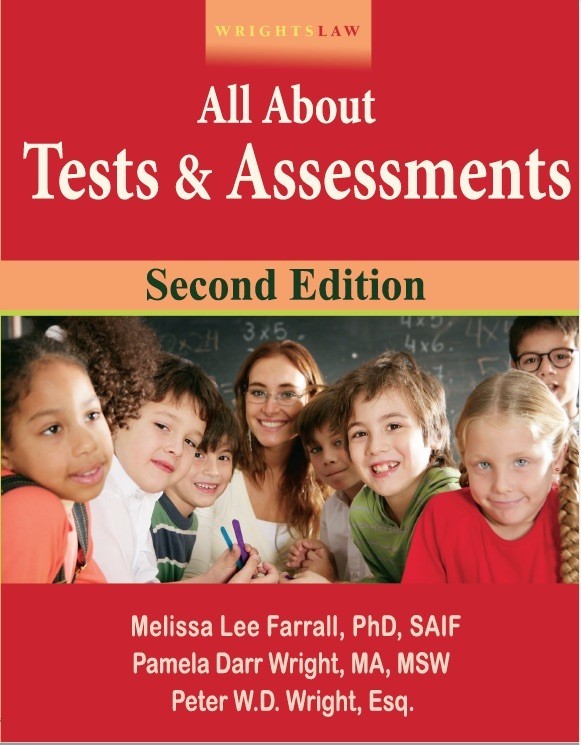 |
Wrightslaw: All About Tests and Assessments, 2nd Edition
- The Wechsler Intelligence Scale for Children, Fifth Edition (WISC-V)
- The Woodcock-Johnson Tests of Achievement, Fourth Edition (WJ IV)
- More than 200 answers to questions about tests in fifteen areas
- Strengths, weaknesses, and potential problems with tests
- Charts of tests that assess specific skills and abilities
- Table of Tests includes the new editions of ten tests with updated publisher and website information.
***** |
|
|

Immediate Download

|
Understanding Your Child's Test Scores by Peter W. D. Wright, Esq
Wow! When I used this training about test scores, I got a new plan, a new evaluation, additional services in the IEP – all in a one hour meeting." Read reviews
In this 1.5 hour program, Pete Wright teaches you about the bell curve, mean, and standard deviations. You'll learn how to draw the bell curve and how to use your child's test scores to create powerful progress graphs. Pete will also teach you about standard scores, percentile ranks, subtest scores, composite or cluster scores, and subtest scatter.
***** | |
|
|
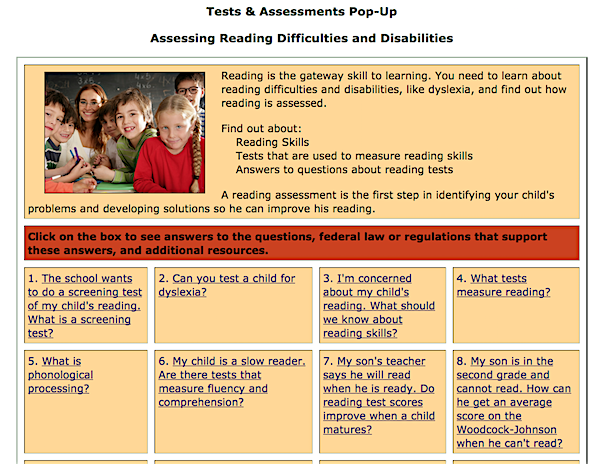
Assessing Reading Difficulties & Disabilities Pop-Up
Reading assessment is the first step in identifying your child's problems and developing solutions so she can improve her reading. Find out about reading skills and what tests are used to measure these skills. |
Download the checklist in pdf format.

|
|