|
|
Print this page
Special Education Caselaw
U.S. Supreme Court l Courts of
Appeals
l District Courts
Noteworthy Cases l Special Education Year in Review Books & Video Training
The Special Education Caselaw section of the Wrightslaw Special Education Law Library is organized as follows.
Decisions from the U. S. Supreme Court are listed first, beginning with Board of Ed. v. Amy Rowley (1982). Decisions from U. S. Courts of Appeals are next, followed by noteworthy decisions from U. S. Districts Courts and administrative decisions.
The Caselaw Library includes a sample of decisions on special education legal issues and does not include every important decision since the law was enacted. If you are looking for Complaints filed in federal court, please check the Federal Court Complaints page. If you are looking for articles about legal issues, please check the Articles and Analyses page.
For additional information about cases and legal research, please check the Directory of Legal and Advocacy Resources.
For articles about special education law and advocacy topics, frequently asked questions, and newsletter archives, please go to the Advocacy Library.
New in 2021
Rogich v. Clark County School District, (Nevada, 2021). Methodology and procedural safeguards case. School district failed to provide an IEP that identified an Orton-Gillingham based methodology or structured literacy format that teachers would have to use to meet the needs of a child with dyslexia; school district refused to accept the parents' offer to pay to train teachers in an effective structured literacy method; IEP teams failed to adequately review evaluations provided by parents and failed to "meaningfully consider parents' concerns for enhancing their child's education." Judge held that telling parents "Trust us to provide what she needs" is "not sufficient."
S.S. v. Cobb Co. Sch. Dist. (N.D. GA 2021) - When "a due process complaint is dismissed without an evidentiary hearing and the reviewing court lacks findings and conclusions on the merits of the plaintiff's claims . . . remand is the most appropriate remedy." Case remanded for due process hearing.
S.C. v. Lincoln Co. Sch. Dist. (9th Cir. 2021) - Administrative law judge held that school district failed to provide child with Prader-Willi Syndrome with a FAPE because child required "total food security" in a schoolwide environment to obtain a meaningful educational benefit; ordered placement at an educational center where these needs could be met. District Court denied parent's request for "stay put". Ninth Circuit reversed denial, remanded for entry of stay-put order at the educational center at school district's expense.
Two Unanimous pro-child U. S. Supreme Court cases in 2017
Fry v. Napoleon Comm. Sch. District
Fry v. Napoleon Comm. Sch. District began as a case about a school's refusal to allow a child's service dog to accompany her in school. After the parents sued for damages under Section 504 and the ADAA, a federal appeals court held that the parents' claim was barred because they failed to exhaust their administrative remedies under the IDEA.
On June 28, 2016, the U. S. Supreme Court granted certiorari in Fry v. Napoleon Comm. Sch. District. Click to learn more about the Fry case, read earlier decisions, and briefs filed with the Supreme Court.
In 2017, the U.S. Supreme Court issued a unanimous decision for child and parents.
Endrew F. v. Douglas County School District RE-1
In Endrew F. v. Douglas County School District RE-1, the parents argued that their child with autism did not make measurable progress on his IEP goals and that the school failed to address his worsening behavior problems. The parents advocated for a heightened 'meaningful educational benefit' standard. On December 22, 2015, after an adverse decision from a federal appeals court, the parents requested that the Supreme Court resolve their educational benefit question. On September 29, 2016, the Supreme Court agreed to hear the case.
Endrew F. v. Douglas County School District RE-1 (No. 15-827) (2017), U.S. Supreme Court unanimously rejected the "de minimis" standard for one that is "markedly more demanding than the 'merely more than de minimis' test applied by the 10th Circuit." In his opinion, Chief Justice Roberts wrote, "a student offered an educational program providing 'merely more than de minimis' progress from year to year can hardly be said to have been offered an education at all."Read Pete's discussion and analysis of this Decision.
Noteworthy Decisions from Courts of Appeals
*** M.C. v. Antelope Valley Union School District. First decision from a Court of Appeals after the Supreme Court issued their decision in Endrew F. M.C. v. Antelope Valley will be a Wrightslaw 2017 Case of the Year.
In Phyllene W. v. Huntsville City (AL) Bd. of Ed. (11th Cir. 2015) the U.S. Court of Appeals for the Eleventh Circuit reversed the decision of a Hearing Officer and of a U. S. District Court and ruled in favor of the parent and child. The Court explained that:
"[T]he Board violated . . . IDEA by failing to evaluate M.W. when faced with evidence that she suffered from a suspected hearing impairment. As a result of its failure to obtain necessary medical information regarding M.W.'s hearing, the Board further failed to provide her with a FAPE. The lack of medical information rendered the accomplishment of the IDEA's goals impossible because no meaningful IEP was developed, and the IEPs put into place lacked necessary elements with respect to the services that M.W. should have been provided. In short, the Board's failure to evaluate M.W. with respect to her hearing loss deprived M.W. of the opportunity to benefit educationally from an appropriate IEP."
Doug C. v. Hawaii (9th Cir. 2013) - Important decision about parental participation at IEP meetings. "All special education staff who conduct IEP meetings should be familiar with this landmark ruling about IEP meetings and parental participation" (Pete Wright) Read Pete's analysis of case. Pete's YouTube discussion is here. The original decision is here.
F. H. v. Memphis City Schools (6th Cir. 2014) - Parent filed suit against school after child was verbally, physically, and sexually abused by his aides at school. School entered into Settlement Agreement with the parent, then refused to honor the Agreement. Court found that Sec. 1983 claims do not require exhaustion under IDEA and that settlement agreement is enforceable in courts.
A.C. v. Shelby County (6th Cir. 2013) - Pro-child 504 retaliation decision in which a principal filed false child abuse allegations against child's parents. For a case of this nature to proceed, there must be a finding that the school district retaliated against the parents for asserting their rights under Section 504.
The Sixth Circuit's 29 page opinion does an exceptional job of explaining the basis and criteria needed for a successful Section 504 suit to proceed against a school district.
Original decision as issued by the Court is located here. The Wrightslaw reformatted version with highlights is located here.
Special Education Legal Developments and Cases ("Year in Review") Books
We have published Special Education Legal Developments and Cases ("Year in Review")
books for each calendar year since 2015.
The Year in Review books include all special education decisions in IDEA and Section 504 cases issued by the U.S. Courts of Appeal for that year, and include cases about discrimination in daycare centers, private schools, medical licensing board exams, and higher education; damages; higher standards for IEPs and Least Restrictive Environment.
The Table of Decisions includes the date, court, synopsis of legal issues, outcome, and prevailing party in the cases. The entry for each case includes the factual background, legal issue(s), and holding of the case.
All Year in Review books are available as immediate PDF downloads from the Wrightslaw Store and as Print books from Amazon.
Video Training |
55 minute MP4 video |
immediate download |
 |
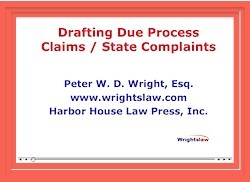 |
Pete Wright created a video about how to write letters to request due process hearings and state complaints. The principles he describes apply to all important letters to the school.
This video will teach you how to use visual imagery to tell a story in your letter. Your letter may become the theme of your case. You will also learn about new OSEP guidance for State Complaints and get links to sample letters.
Click to learn more about the video and watch the trailer. |
|
Decisions
from U.S. Supreme Court
(issued prior to our "Year in Review" series which began in 2015)
Brown
v. Bd of Education, 347 U. S. 483 (1954). In this landmark decision,
the Supreme Court found that segregated public schools are inherently
unequal; decision is relevant to children in segregated special education
placements.
Bd of Ed of City of New York v. Tom F (2007). The question before the Court was whether parents of a child who has never received special education from the public school district can obtain reimbursement for a unilateral private placement. The U. S. Supreme Court issued a split decision (4-4) in the case. Justice Kennedy recused himself. The favorable decision stands for families who live in the Second Circuit - Connecticut, New York, and Vermont. Read about the key events in A Short History of New York Bd of Education v. Tom F., on Behalf of Gilbert F.
Fitzgerald v. Barnstable, 555 U.S. 246 (2009). In a unanimous decision, the Court reinstated the lawsuit filed by the parents under Title IX, which bars gender discrimination at schools that receive federal funds, and under Section 1983, a broader civil rights law.
Forest Grove School District v. T.A. (2009) In a 6-3 decision, the Court held that IDEA allows reimbursement for private special education services, even when the child did not previously receive special education services from the public school. Read decision. / Read analysis.
Safford v. Redding, 557 U.S.__ (2009). Court held that school officials violated a thirteen year old girl's Fourth Amendment right to be free from unreasonable search and seizure when they strip searched her after receiving a "tip"that the girl possessed ibuprofen.
Virginia Office of Protection & Advocacy v. Stewart (2011) Supreme Court held that the Virginia Office for Protection & Advocacy (VOPA) can sue the state and pursue other legal remedies necessary to fulfill their duty to advocate for people with disabilities.
J. D. B. v. North Carolina (2011) - Where police interrogated a 13 year old middle school student at school but did not give a Miranda warning, Supreme Court holds that a child's age is relevant to the Miranda custody analysis. Reversed and remanded.
To Top
Decisions from U. S. Courts of Appeals
(issued prior to our "Year in Review" series which began in 2015)
A.K., a minor by his Parents and Next Friends J.K. and E.S., v. Alexandria City School Bd. (4th Cir. 2007) - Decision affirmed policies served by the requirement of a formal written offer that creates "a clear record of the educational placement and other services offered to the parents." The school district's "offer of an unspecified 'private day school' was essentially no offer at all.
Amanda
C. v. Clark Co Sch. Dist. & Nevada Dept. of Ed, (9th Cir. 2001) This strongly written decision cites research
about ABA/Lovaas treatment; describes purposes of the IDEA; IEPs and
proceduralsafeguards. District's failure to provide parents with
evaluations adversely affected parents' ability to make decisions
and damaged child; district failed to provide FAPE; standard of review
in two-tier system; credibility of witnesses.
Anchorage School District v. MP (9th Cir. 2012) In awarding reimbursement to the parents, the Court noted that "we are sympathetic to the difficulties posed by the obviously strained relationship between the ASD and M.P.'s parents, but this circumstance does not excuse the ASD from compliance with the IDEA. To conclude otherwise would subvert the purposes of the IDEA and sanction a school district's unilateral decision to abandon its statutorily required responsibility to the detriment of its students."
Baird
v. Rose (4th Cir. 1999)
Stong decision on behalf of depressed child who was tormented and
humiliated by her teacher.
Bartlett
v. New York Law Examiners, (2nd Cir. 1998) ADA case about reasonable accomodations for bar exam.
Cavanaugh v. Cardinal Local Sch. Dist. (6th Cir. 2005) Sixth Circuit held that parents cannot proceed pro se on behalf of their children under IDEA and that parents have no substantive claim of their own to a free appropriate public education.
C.B. v. Garden Grove Unified Sch. Dist. (9th Cir 2011) - CA chool failed to provide FAPE; guardian placed child in private program and requested reimbursement. ALJ found that child received "significant educational benefits" but only ordered reimbursement for half of tuition because private program did not meet all child's needs. District Court reversed, awarded full reimbursement. School appealed.
Cedar
Rapids v. Garret (8th Cir. 1998) This case on behalf of a
child who needed related services to attend school was later heard by the U. S. Supreme Court; download decision by the Supreme
Court.
Cleveland
Heights-University Heights v. Sommer Boss (6th Cir. 1998) Case involves vague IEP goals & objectives, failure to provide
FAPE, tuition reimbursement.
Collingsru
v. Palmyra Bd. of Education (3rd Cir. 1998) Can a non-attorney parent represent his or
her child in court? Why? Why not?
Connecticut Office of Protection and Advocacy for Persons with Disabilities v. Hartford Bd of Educ, Hartford Public Schools and Robert Henry, Sup. of Schools (2nd Cir 2006) The Court held that the P & A has a statutory responsibility to investigate suspected cases of abuse and neglect of individuals with disabilities or mental illness and found probable cause that "multiple individuals have been subjected to abuse or neglect" at Hartford Transitional Academy.
Covington
v. Knox Co (TN) (6th Cir. 2000) Decision in "time-out
Room" abuse case; creates exceptions to exhaustion requirement in damages
cases. In
html
Disability Rights Wisconsin, Inc., v. v. Wisconsin Dept. of Public Instruction & Elizabeth Burmaster, Superintendent of Public Instruction (7th Cir. 2006) The decision includes a detailed description of the responsibilities of P & As to protect individuals with disabilities, limitations on confidentiality under the Family Educational Rights to Privacy Act, and other issues.
Zachary
Deal v. Hamilton County TN Board of Ed (6th Cir. 2004) Wide-ranging decision about standard
of review, additional evidence, judicial notice, procedural &
substantive IDEA violations, FAPE, educational benefit, predetermination
of placement, failure to include regular ed teacher, reimbursement.
Doug C. v. Hawaii (9th Cir. 2013) - The Ninth Circuit issued an important decision about parental participation at IEP meetings. Pete says that "Both parents and all special education staff who conduct IEP meetings should be familiar with this landmark ruling about IEP meetings and parental participation." Click here to read Pete's comprehensive analysis about the case. Pete's YouTube discussion is located here. The original decision as issued by the Court is located here.
Jarron Draper v. Atlanta Independent School System (11th Cir. 2008) - Affirmed District Court and ordered Atlanta Independent School System to pay tuition and expenses at a private special education school for four years or until child graduates from high school as prospective compensatory education for their failure to provide him with a free appropriate education over a period of many years.
Eason
v. Clark County School Distric (NV). (9th Cir. 2002) Court reverses
District Court; school personnel do not have immunity. (joined with
Witte
v. Clark County Sch. District)
Fales
v. Garst (8th Cir. 2001) Three
special ed teachers filed suit against principal who tried to block
them from advocating for students; free speech v. employers rights.
In
pdf In
Word Complaint
in Fales v. Garst
Lisa Ryan Fitzgerald, etc., et. al. v. Barnstable School Committtee, et. al., 504 F. 3d 165. Court of Appeals for the First Circuit held that plaintiffs were precluded from using section 1983 to redress deprivations of Title IX, a federal statutory right, and a federal constitutional right under the Equal Protection Clause under applicable Supreme Court doctrine. In January 2009, the Supreme Court reversed.
Florence County School Dist. IV v. Shannon Carter (4th Cir. 1991) After Florence County lost in District Court, they appealed to the Fourth Circuit. While arguing that four months a year of progress in reading was appropriate, the district also argued that because Trident Academy was not on the State's "approved" list, Shannon's parents should not be reimbursed for the placement. Court discussed"least restrictive environment" and a contrary Second Circuit case. This ruling for Shannon created a "split" among circuits that opened the door to an appeal to the U. S. Supreme Court in Florence County School District Four v. Shannon Carter.
Forest Grove Sch. Dist v. T.A. (9th Cir. 2008) - In a 2-1 decision, the Court of Appeals ruled that parents who unilaterally enroll their disabled child to a private school may be entitled to tuition reimbursement from the school district although the child never received special education from the district. On 1/16/09, The Supreme Court agreed to hear the case. (see 2011 District Court decision in Forest Grove v. T.A.)
Forest Grove v. T.A.-II. On remand from the Supreme Court, the U.S. District Court holds that boy had drug and behavior problems; that parental placement in a private school was for non-disability reasons so parents not entitled to reimbursement for his tuition. In a split decision, the 9th Circuit upheld the District Court's ruling. Read new decision in Forest Grove v. T.A.-2 (4/27/11)
G.
v. Fort Bragg Dependent Schools (4th Cir. 2003). ABA/Lovaas
case; rights of children who attend Dept of Defense schools; FAPE
& educational benefit; methodology; reimbursement for home-based
Lovaas program; procedural safeguards and notice by parents; compensatory
education for failure to provide FAPE; prevailing party status &
attorneys fees.
G.
v. Cumberland Valley (3rd Cir. 1999)
Tuition reimbursement for 2 children with dyslexia, LRE and "vigorous advocacy" by parents.
C.B. v. Garden Grove Unified Sch. Dist. (9th Cir 2011) - California school failed to provide FAPE. Child's guardian withdrew child from public school and placed child in Reading & Language Center, a non-public program. ALJ found that child received "significant educational benefits," but only ordered reimbursement for half of tuition because private program did not meet all child's needs. District Court reversed ALJ, awarded full reimbursement. School appealed. 9th Cir. upheld Dist. Ct decision.
HH v. Moffett & Chesterfield School Bd (4th 2009) - Special ed teacher and a assistant restrained child in her wheelchair for hours during the school day while they ignored her, verbally abused her, and schemed to deprive her of educational services. In an unpublished decision, the Court held that their conduct "violated H.H.’s clearly established right to freedom from undue restraint under the Fourteenth Amendment, and Appellants are therefore not entitled to qualified immunity as a matter of law."
Hartmann
v. Loudoun County
(4th Cir. 1997) inclusion and LRE
for child with autism.
Joseph
James v. Upper Arlington Sch. District (6th Cir. 2000) Decision about tuition reimbursement for
child with dyslexia, statute of limitations, procedural
safeguards. pdf html
Jaynes
v. Newport News Public Schools (4th Cir. 2001) Case on behalf of child with autism whose parents provided intensive homebased
ABA/Lovaas program; statutes of limitations, procedural
safeguards, notice requirements, and reimbursement.
JP v. Sch. Bd of Hanover County VA (4th Cir. 2008). Reversed decision of the District Court regardling deference to hearing officer's findings of fact; remanded to District Court to reconsider if IEP offered by school provided child with FAPE. In December 2008, the U.S. District Court issued a new decision in JP v. School Board of Hanover County VA (E.D. VA 2008), found that the State Hearing Officer's decision was not consistent with the record, that HCPS did not provide JP with a FAPE, and that the parents were entitled to tuition reimbursement for their child's education in a private special education school. More info
J.
S. v. Isle of Wight VA Sch. Bd (4th Cir. 2005) Money damages are not available because Congress intended disabled
children to pursue claims to FAPE through remedial mechanisms in the
IDEA statute; extensive discussion of statute of limitations and federal "borrowing" doctrine.
KM v. Tustin Unified School District (9th Cir. 2013) - Court of Appeals issued decision about the relationship between IDEA, Section 504 and ADA AA. The Court relied on a brief filed by the U.S. Department of Justice, located here.
Knable
v. Bexley City Sch. District (6th Cir. 2001) Case about child with behavior disorder; includes discussion of IEPs, draft IEPs, IEP requirements,
tuition reimbursement, placement, burden of proof, more.
L.B.
and J.B. ex rel. K.B. v. Nebo UT School District (10th Cir. 2004) Parents of child with autism reimbursed
for ABA therapy and private preschool which was LRE; impartiality of
hearing officer.
ISD
No. 284 Wayzata Schools v. A.C. (8th Cir. 2001) Decision about need to pay costs of residential
program for child with emotional and behavioral problems; overturns
ruling in federal district court that residential placement was
not "educationally necessary."
Mackey
v. Arlington Central School District, State Education Dept (2nd Cir. 2004) In
"stay-put" / pendency case, Court finds that parents are entitled to reimbursement
for private school tuition because earlier denial was a result of
delays and an untimely decision by the state review officer.
Maroni
v. Pemi-Baker Regional School District (1st Cir. 2003) Decision breaks new ground, Court rules that parents can
pursue IDEA claims in federal court without an attorney.
M.L.
v. Federal Way School District (WA) (9th Cir. 2004) Court found that the failure to include a regular
education teacher on the IEP team was a serious procedural error
that led to a loss of educational opportunity and a denial of FAPE.
Muller
v. East Islip (2nd Cir. 1998) Decision about eligibility, damages, discusses Rowley,
Burlington,
and Carter.
Peck
v. Lansing (8th Cir. 1998)- Can
a child receive special education or related services at her parochial
school? Does this violate the Establishment Clause?
Phyllene W. v. Huntsville City (AL) Bd. of Ed.(11th Cir. 2015) - the U.S. Court of Appeals reversed the decision of a Hearing Officer and a U.S. District Court and ruled in favor of the parent and child. The Court explained that:
"[T]he Board violated . . . IDEA by failing to evaluate M.W. when faced with evidence that she suffered from a suspected hearing impairment. As a result of its failure to obtain necessary medical information regarding M.W.'s hearing, the Board further failed to provide her with a FAPE. The lack of medical information rendered the accomplishment of the IDEA's goals impossible because no meaningful IEP was developed, and the IEPs put into place lacked necessary elements with respect to the services that M.W. should have been provided. In short, the Board's failure to evaluate M.W. with respect to her hearing loss deprived M.W. of the opportunity to benefit educationally from an appropriate IEP."
Polera
v. Bd Ed. Newburgh City Sch. Dist. (2nd Cir. 2002) In damages case under Section 504 and
ADA, court rules that disabled child must first exhaust administrative
remedies under IDEA. Decision includes extensive discussion of
relief under statutes, compensatory and punitive damages, exhaustion
requirement, and futility exception.
Porter
v. Bd of Trustees of Manhattan Beach USD (9th
Cir. 2002)- Parents of child for whom special education program was ordered
by hearing officer were not required to seek new hearing
nor comply with state’s complaint procedure
before suing for failure to fully implement the program;
that Eleventh Amendment immunity does not bar a federal
court from granting prospective injunctive relief.
R.E., M.E., et al v. NYC Dept of Education (2nd Cir. 2012) - 2nd Circuit adopts the “snap-shot” rule to judge the adequacy of an IEP written in Burlington/Carter reimbursement cases; held that retrospective testimony about additional services that the also district "would have provided," but which were not offered in the IEP, cannot be used to rehabilitate an IEP or prove its adequacy.
School
Bd of Henrico County VA v. Z.P (4th Cir. 2005) Parents of child with autism rejected
traditional public school preschool program and requested tuition reimbursement
for private program that utilized one-on-one ABA therapy. Other
issues included deference to hearing officer as fact finder and
deference to professional educators.
Sellers
v. Manassas, (4th Cir. 1998)
Court finds that damages are not available under IDEA and Section
504.
Settlegoode v. Portland Public Schools, (9th Cir 2004) Court upheld
jury verdict, reinstated 1 million dollar award to special ed
teacher who was retaliated against and fired for advocating for
her students; decision clarifies freedom of speech for teachers.
Decision
in pdf
T.
R. v. Kingwood Township (NJ) (3rd Cir. 2000) Court clarifies FAPE and "meaningful benefit," requirement
about continuum of placements; requirement to provide a free appropriate
education (FAPE) in the least restrictive environment.
W.B.
v. Matula (3rd Cir. 1995) Court found that damages available under Section 504, IDEA, and Section 1983 when district
refused to evaluate, classify and provide appropriate services
to disabled child; decision also addressed exhaustion, qualified immunity, due process; decision superceded by a later decision that damages not available under IDEA.
Walczak
v. Florida Union Free School District (2nd Cir. 1998) Case about tuition reimbursement, maximizing
v. appropriate; parents are not entitled to what is "best"
for their children. Weast
v. Schaffer (4th Cir. 2004) Decision
focuses on parental knowledge and burden of proof; appealed to the U. S. Supreme Court. U.
S. Supreme Court granted cert on 2/22/05.
Westendorp
v. Independent School District No. 273 (8th Cir. 1998) Provision of special education services at
a private religous school; right to services under IDEA v. IDEA
97. Note: caselaw around the country is inconsistent about this
issue.
Jacob Winkelman, et al. v. Parma City Schools (6th Cir. 2005) - Court held that "IDEA does not grant parents the right to represent their child in federal court." Unless parents retain an attorney, the child's case will be dismissed. The Supreme Court granted cert to resolve a split among circuits on this issue; a decision is expected during the 2006-2007 term. (pdf format)
Winkelman v. Parma City Sch. Dist. (6th Cir. 2006) In a case on behalf of a child with autism, Court held that the school district's proposed placement was appropriate, that the parents' placement in a private school that educates children with autism was not the child's "stay put" placement pursuant to IDEA. (pdf format)
Yankton
School District v. Schramm
(8th Cir. 1996) Eligibility, Section
504, termination of special education services, attorney's fees.
Decisions
from U.S. District Courts
Charter School in Contempt, Must Pay $176,722 - On November 4, 2013, pursuant to the "stay-put / pendency" statute (20 USC 1415(f)), the U.S. District Court of Arizona held the "tuition-free, public charter" Flagstaff Arts and Leadership Academy in contempt of Court and ordered them to pay $176,722.00 for the child's private placement by November 15, 2013 or face further sanctions. (Click here for ruling of Contempt and Order to pay.)
While the child was enrolled in the charter school, the parents contested the IEP, removed the child to a private placement, and requested a due process hearing. The Administrative Law Judge ruled in their favor, (click here for decision).The school appealed and the parent's attorney, Hope Kirsch filed a Counterclaim. (Click here for Counterclaim). The Charter School asserted that they could not afford to pay. The Court noted that their problem is "an allocation of resources problem, not an absence of resources."
PV v. Philadelphia - The US District Court Judge approved the case as a class action suit;held that changing placements of children with autism without convening IEP meetings, excluding parents participation, providing minimal notice about new placements, and educational placement decisions made by division directors were violations of the IDEA.
Burriola v. Greater Toledo YMCA (W.D. OH 2001) In ADA case, federal
Judge issued injunction, orders day care center to readmit child with
autism; staff must be trained; discussion of reasonable accommodations,
exhaustion, training. In
pdf In
html Analysis
of Burriola case by Tom Zraik, attorney for child.
Shannon
Carter v. Florence County Sch. Dist. IV. (SC 1990) - Tuition reimbursement case
that was appealed to the U. S. Supreme Court; decision focuses on an
appropriate program and IEP for Shannon, a child with dyslexia.
Community
Consolidated Sch. Dist. #93 v. John F. (IL) (N.D. IL 2000) Important discipline
case; procedural violations, prior written notice requirements, manifestation
determination review, suspensions for more than 10 days, expedited hearings,
special education and related services under IDEA, "passing grades"
and FAPE, homebound instruction violates LRE, more. In
Word In
pdf
Jarron Draper v. Atlanta Public School District [Draper II] (N.D. GA 2008) Court denies motion by Atlanta Public Schools (“APS”) to dismiss Jarron’s civil rights claims that APS discriminated against him, harassed him, and retaliated against him and his family; requesting damages under Section 504. (PDF)
Jarron Draper v. Atlanta Independent School System [Draper I] (N.D. GA 2007) - School district misdiagnosed a dyslexic boy as mentally retarded, placed him in self-contained program for years where he did not learn to read. School district failed to complete three-year reevaluation, as required by law. The Court ordered the school system to provide J.D. with compensatory education at private special education school for four years or until he graduates with a regular high school diploma.
Evans
v. Rhinebeck Central Sch Dist, (S.D. NY 1996) Excellent case about tuition reimbursement, procedural
and substantive issues, FAPE, dyslexia, objective measurement of progress.
Gerstmyer
v. Howard Co. Schools (MD 1994) Tuition
reimbursement for private non-special ed school; inappropropriate IEP
goals and objectives for child with dyslexia. Parent's counsel, Wayne
Steedman charted new territory with this case.
Goleta
Union Elementary Sch. Dist v. Andrew Ordway (C.D. Cal. 2002). Judge
rules that school administrator was personally liable for damages under
the Civil Rights Act for violating a mother's right to get a "free
appropriate public education" for her special-needs son, as required
by the Individuals with Disabilities Education Act (Dec 2002). (in pdf)
Henrico County School Board v. R. T. (E.D. VA 2006). Tuition reimbursement case for young child with autism; comparison of TEACCH and ABA; FAPE and least restrictive environment; deference to decision of hearing officer; witness credibility; impact of low expectations and "an insufficient focus on applying replicable research on proven methods of teaching and learning"
Jacob Winkelman v. Parma City School District (N.D. OH 2005). Challenging the decision of the State Board of Education that the District's proposed program was the LRE and provided FAPE under IDEA, the Winkelmans requested, as pro se litigants, that the district court reverse the administrative decisions and reimburse them for the cost of all education related services and placements. The court denied the Winkelmans' motion and granted the District's motion.
JP v. School Board of Hanover County VA (E.D. VA 2008). Tuition reimbursement case for child with autism. In JP-1 (2006), the District Court judge found the hearing officer's decision regarding witness testimony inadequate, charted out child's test scores and determined that school district did not provide FAPE. In February 2008, the Court of Appeals for the Fourth Circuit reversed and remanded the case back to the District Court to determine if the 2005 IEP provided FAPE.)
UPDATE: In December 2008, the Court issued a new decision in JP v. School Board of Hanover County VA (E.D. VA 2008) and found that the "State Hearing Officer's decision was not consistent with the record, that HCPS did not provide JP with a FAPE during the 2005-2006 school year because it did not proffer an IEP that was reasonably calculated to provide educational benefit. The Court held that private placement at Dominion School was appropriate and JP's parents are entitled to tuition reimbursement.
J.L. and M.L., and their minor daughter, K.L. v. Mercer Island (WA) School District - In finding that the standards for a free appropriate public education described by the Supreme Court decision in Board of Ed. of Hendrick Hudson Central School District v. Rowley are no longer relevant, the Court cited changes in recent IDEA reauthorizations that are so significant "that any citation to pre-1997 case law on special education is suspect." Update: On 01/13/10, this decision was reversed by the U.S. Court of Appeals for the Ninth Circuit.
Judith
Scruggs, Administratix of Estate of Daniel Scruggs v. Meriden Bd of
Ed., E. Ruocco, M. B. Iacobelli, and Donna Mule (U. S. District
Court, Connecticut, 2005). Suit for actual and punitive damages against
school board, superintendent, vice principal and guidance counselor
under IDEA, ADA, 504, 42 USC 1983, 1985 and 1986. Child bullied, harrassed
in school for years while school personnel looked on, did nothing. Child
committed suicide. Includes a discussion of why parent did not have
to exhaust admininistrative remedies under IDEA.
Stefan
Jaynes v. Newport News Public Schools (E.D. VA 2000) Parents reimbursed for ABA Lovaas program for
child with autism, procedural safeguards, notice, statute of limitations. Appealed to Fourth
Circuit (2000). In
pdf In
Word
Tereance D. and Wanda D. v. Sch. Dist. Philadelphia (E.D. PA 2008) - District failed to provide FAPE for many years; performed inadequate evaluations; misdiagnosed child as mentally retarded and emotionally disturbed; misled the parent about her son's rights to autism services and ESY services, more.
Daniel
Lawyer v. Chesterfield Sch. Bd (E.D. VA 1993) This decision includes
good discussion about factors to consider in extended school year (ESY), including regression and recoupment,
autism and neurological windows of opportunity.
Mr.
X v. NY (S.D. NY 1997) Excellent case includes comprehensive
discussion of autism, Lovaas, ABA therapy and TEACCH.
Reusch
v. Fountain
(MD) One of the earliest and leading cases about extended school year (ESY).
Linda
Sturm v. Rocky Hill Bd of Ed (CT 2005) Special ed teacher can sue school district for retaliation
because Section 504 includes anti-retaliation provisions and courts
have extended protection against retaliation for those who advocate
for the disabled.
T.
H. v. Palatine, (N.D. IL 1999) Comprehensive decision
in ABA-Lovaas case. Includes thorough discussion of the IEP process,
the need to individualize the IEP, methodology and placement issues.
(This decision is in pdf format)
To Top
Other
Noteworthy Decisions + Documents
Offfice of Civil Rights, Restraint/Seclusion - Prince William County, VA
On July 23, 2014, OCR found that the school district violated Section 504 of the Rehabilitation Act by "failing to re-evaluate students to determine if they needed additional or different related aids and services given the frequent use of restraint, seclusion, and . . . removing students from their classrooms to an isolated area." Click here to read the letter.
U.S. Dept of Justice v. Day Care Center
On November 27, 2013, the USDOJ and Camelot Day Care Center in Edmond, OK entered into a Settlement Agreement. The child, with Down Syndrome and toileting issues, was denied participation in field trips. In addition to paying $3,000 to the parents, the child will have a full year, tuition free, at Camelot. Click here to read the Settlement Agreement.
The
parents' "Letter
to the Stranger" and James
Brody's description of the due process hearing are among dozens
of articles in The Advocacy Libraries.
Zachary
Deal v. Hamilton Dept of Educ (TN Due Process Decision 2001)
The administrative law judge issues 45 page decision after a 27-day
due process hearing; finds procedural safeguards and LRE violations;
substantive violations; discusses credibility problems with school
witnesses re: closed minds, evasiveness.
Doe
v. Withers. Case stood for two significant propositions: that schools
and teachers can be held accountable for refusing to follow IEPs and
that schools and teachers can be sued for dollar damages in jury trials.
This was the first special education jury trial against public school
educators. Click here to read the Complaint and here to read the Jury
Order in Doe v. Withers.
Note to Non-lawyers
U.S.
Supreme Court cases are supreme. Cases from U. S. Courts of Appeals
are the next highest level of judicial decisions. Rulings from a U.
S. Circuit Court of Appeals have binding authority over the Courts in
the states of that Circuit.
It is important
to stay on top of the rulings of the U. S. Courts of Appeals.
States may not be bound by a ruling from a different circuit but may
rely upon a decision as "persuasive authority." When the
Circuits have "split" rulings on the same issue, i.e., different
legal outcomes from similar issues of fact and or law, these cases have
a higher probability of being accepted for review by the U. S.
Supreme Court. This is what happened in Shannon Carter's case.
Parents, as you read these cases, do not focus on your child's disability and how the facts in the case are different from your child. Substitute your child's disability with the one discussed in the case. While the facts may change, so often the legal principles are the same, without regard to the particular disability. Do not have tunnel vision as you read. Consciously think about how the ruling in this case relates to your child.
To Top
Last Revised: 10/18/2021
|
|