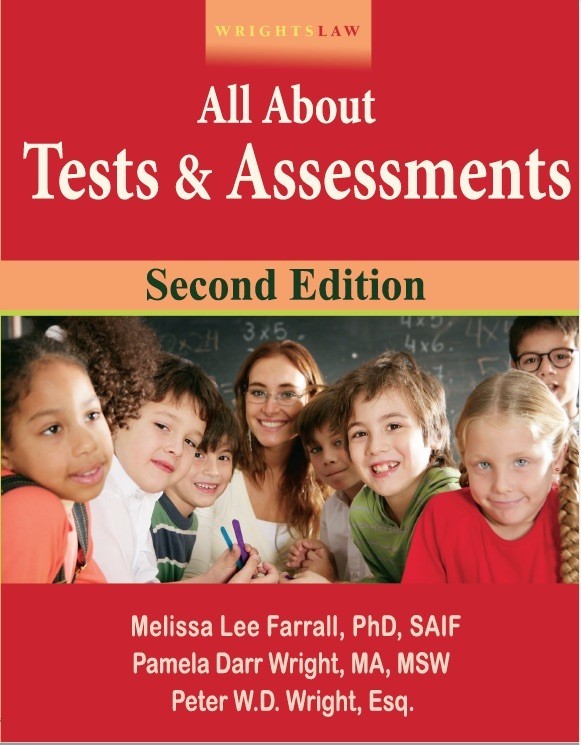
"What
do test scores really mean?" "What
do test scores really mean?" Most
parents have questions and concerns about their child's tests and evaluations.
Sometimes, the answers you get from school personnel just don't add up. You will
learn the basics in our famous article, Understanding
Tests and Measurements for the Parent and Advocate.
For
more information, check the resources on this page. NOTE: We recently removed
some books from this page because the books are being revised. When the revisions
become available, we'll add these books with new links.
 Reading Assessment - Linking Language, Literacy, and Cognition by Melissa Lee Farrall, PhD. Reading Assessment - Linking Language, Literacy, and Cognition by Melissa Lee Farrall, PhD.
A groundbreaking integrated approach to reading assessment that addresses each child's unique learning profile.
Reading Assessment is an invaluable resource that helps professionals gain the knowledge and skills to confidently interpret test results and prepare detailed and effective evaluation reports designed to meet each child's unique needs as a learner.
Author Melissa Lee Farrall explores the theoretical underpinnings of reading, language, and literacy, explains the background of debates surrounding these topics, and provides detailed information and administration tips on the wide range of reading inventories and standarized tests that may be used in a reading psychoeducational assessment.
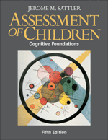 Assessment of Children: Cognitive Foundations + Resource Guide to Accompany
Assessment of Children: Cognitive Foundations by Jerome M. Sattler Assessment of Children: Cognitive Foundations + Resource Guide to Accompany
Assessment of Children: Cognitive Foundations by Jerome M. Sattler
Fifth edition is designed as both a teaching text and a reference source for students and professionals. It is a major revision.
Every chapter has been rewritten to make the text more comprehensive, relevant, readable, up to date, and informative. The text contains new material on issues related to intelligence, ethical guidelines related to assessment, laws pertaining to children with disabilities, the Stanford-Binet Intelligence Scales–Fifth Edition (SB5), the Differential Ability Scales–Second Edition (DAS–II), and brief intelligence tests. It also incorporates all of the chapters contained in Assessment of Children: WISC–IV and WPPSI–III Supplement.
New to the Fifth Edition is the Resource Guide to Accompany Assessment of Children, Cognitive Foundations.
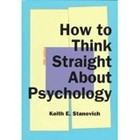 How
to Think Straight About Psychology (Keith Stanovich, ed.) is a "Consumer's
Guide" to psychology. Stanovich wrote this book for the "consumers of psychological
information" - which includes you, the parents of special ed kids. How
to Think Straight About Psychology (Keith Stanovich, ed.) is a "Consumer's
Guide" to psychology. Stanovich wrote this book for the "consumers of psychological
information" - which includes you, the parents of special ed kids.
Keith Stanovich is the psychologist who coined
the term The Mathew Effect ("the rich grow richer, the poor get poorer")
to describe the impact of reading disorders. How
to Think Straight About Psychology"is a wise, thoughtful book about the
scientific method, and how we use these techniques to arrive at an understanding
of the world. It talks about the nature of knowledge, what scientific truth is,
and how common misconceptions lead us astray." Click
to order How to Think Straight About Psychology.
Assessment of Children: Cognitive Applications (4th edition) by Jerome M. Sattler.
 Excellent book about assessments and tests for the professional, attorney, and the curious parent. Dr. Sattler's book includes a Bell Curve with percentile ranks for the Wechsler IQ tests, subtest scores, and most other tests that are used with children who receive special education services. Excellent book about assessments and tests for the professional, attorney, and the curious parent. Dr. Sattler's book includes a Bell Curve with percentile ranks for the Wechsler IQ tests, subtest scores, and most other tests that are used with children who receive special education services.
Assessment of Children: WISC-IV and WPPSI-III Supplement by Jerome M. Sattler.
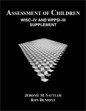 "This is a well-written and timely text that addresses the content comprehensively and is written by two authors with exceptional credibility. It is not just appropriate, but perhaps essential reading for those working with the WISC-IV and WPPSI-III." "This is a well-written and timely text that addresses the content comprehensively and is written by two authors with exceptional credibility. It is not just appropriate, but perhaps essential reading for those working with the WISC-IV and WPPSI-III."
You can order Dr. Sattler's books from his publishing site.
|
 Assessment of Children: Behavioral, Social, and Clinical Foundations by Jerome M. Sattler and Robert Hoge. Assessment of Children: Behavioral, Social, and Clinical Foundations by Jerome M. Sattler and Robert Hoge.
Like former editions, the fifth edition of Assessment of Children: Behavioral, Social, and Clinical Foundations is designed not only as a teaching text but also as a reference book for students and professionals. This is a major revision.
Every chapter has been rewritten to make the text more comprehensive, relevant, readable, up to date, and informative. The book contains new chapters on assessment theory, psychometrics, culturally and linguistically different children, and report writing. We have given expanded coverage to broad measures of behavioral, social, and emotional functioning and to parenting and family variables. In addition, we have included reviews of specific measures for assessing antisocial behavior disorders, anxiety disorders, depressive disorders, risk of suicide, and substance abuse disorders.
 The Special Educator's Comprehensive Guide to 301 Diagnostic Tests by Roger Peirangelo, Ph.D and George Guiliani, J.D. Psy.D. The Special Educator's Comprehensive Guide to 301 Diagnostic Tests by Roger Peirangelo, Ph.D and George Guiliani, J.D. Psy.D.
For anyone involved in the special education process, this book provides a comprehensive practical guide to the most frequently used and helpful tests for diagnosing suspected disabilities of all kinds - intellectual, perceptual, language, achievement, psychosocial, and social maturity - from the early childhood years through adolescence.
This greatly expanded second edition contains explanations of 301 new and enhanced tests, which are vital to understanding assessment in special education. Designed as an easy-to-use, hands-on resource. the book is filled with practical tools, information, and suggestions. Step-by-step, this practical guide explores the various stages of evaluation, interpretation, diagnosis, prescription, and remediation. You'll find detailed information on the make-up and purpose of each of the 301 different tests.
Special
Educator's Complete Guide to 109 Diagnostic Tests by Roger Pierangelo
& George A. Giuliani
(Second Edition now available. See The Special Educator's Comprehensive Guide to 301 Diagnostic Tests)
A guide
to most frequently used tests for diagnosing suspected disabilities of all kinds
- intellectual, perceptual, language, achievement, psychosocial and social maturity
- from early childhood through adolescence. Includes information about the make-up
and purpose of each of the 109 tests, including subtests, scoring, diagnostic
patterns, strengths and weaknesses.
Children's
Psychological Testing : A Guide for Nonpsychologists by David L. Wodrich
 "This
highly acclaimed resource explains in layman's terms the principles behind psychological
testing, the definitions of key terminology, and how psychologists interpret test
data." (from review) "This
highly acclaimed resource explains in layman's terms the principles behind psychological
testing, the definitions of key terminology, and how psychologists interpret test
data." (from review)
To ensure that
children receive appropriate services, parents, advocates and attorneys need to
understand what psychological tests measure and what the test scores mean.
In Children's
Psychological Testing: A Guide for Nonpsychologists, you'll learn about
the validity and reliability of the most frequently used measures of intelligence,
abilities, and educational achievement. Focuses on test instrument used to identify
children who are eligible for special education services under IDEA and in developing
IEPs. From making referrals to identifying
developmental delays or adolescent depression, this book will help parents, advocates,
educators, and attorneys work more effectively with the psychologists who administer
and interpret children's tests and evaluations.
|