| You
know that your child has a disability. What
do you know about your child's disability - specifically?
How
does the disability affect the child's school performance? In what areas?
Can the child's disability be minimized or "cured" through intensive remediation?
What are the child's strengths? What tools can be used to minimize the impact
of the disability?
Step One of your Game Plan is to become an
expert about your child's disability. Read at least one book about your child's
disability - several books are better. You will find several good books about
children's disabilities on this page - let us know if you find a helpful book
so we can include it.
 The Way I See It by Temple Grandin. The Way I See It by Temple Grandin.
In the revised and expanded version of this innovative book, Dr. Temple Grandin gets down to the REAL issues of autism, the ones parents, teachers, and individuals on the spectrum face every day. Temple offers helpful do’s and don’ts, practical strategies, and try-it-now tips, all based on her “insider” perspective and a great deal of research. Topics include: How and Why People with Autism Think Differently, Economical Early Intervention Programs that Work, How Sensory Sensitivities Affect Learning, Behaviors Caused by a Disability vs. Just Bad Behaviors, Teaching People with Autism to Live in an Unpredictable World, etc.
 The Dyslexic Advantage: Unlocking the Hidden Potential of the Dyslexic Brain by Brock L. Eide, Fernette F. Eide. The Dyslexic Advantage: Unlocking the Hidden Potential of the Dyslexic Brain by Brock L. Eide, Fernette F. Eide.
Neurolearning experts Drs. Brock and Fernette Eide describe an exciting new brain science that reveals that people with dyslexia have unique brain structure and organization. While the differences are responsible for certain challenges with literacy and reading, the dyslexic brain also gives a predisposition to important skills, and special talents.
 Different Learners: Identifying, Preventing, and Treating Your Child's Learning Problems by Jane M. Healy Ph.D. Different Learners: Identifying, Preventing, and Treating Your Child's Learning Problems by Jane M. Healy Ph.D.
When parents are told that their child is having difficulty in school, they often don’t know where to turn for reliable information and advice. They may be confused by conflicting claims of "cures" or may mistakenly think that, because some learning problems are genetically based, they can do nothing to help. Even the terminology of learning disorders is confusing: dyslexia, dyscalculia, ADD, ADHD, autism, Asperger’s syndrome, NVLD, executive function disorder—what are all these conditions, how do they differ from one another and, most important, what practical steps should parents and teachers take to remedy the situation?
Legacy of the Blue Heron: Living with Learning Disabilities
by Harry Sylvester.
This book is a story of persistence in the face of misunderstanding, a story of survival by patient perseverance through years of puzzlement and frustration, and much more.
Harry Sylvester shares with us many lessons he learned the hard way, during the years in which our society was discovering what learning disabilities are.
 The Learning Tree: Overcoming Learning Disabilities from the Ground Up
by Stanley Greenspan and Nancy Thorndick Greenspan.
The Learning Tree offers a new understanding of learning problems. Rather than looking just at symptoms, this new approach describes how to find the missing developmental steps that cause these symptoms.
The best solution to the problem comes from knowing what essential skills to strengthen.
How
to Reach and Teach ADD/ADHD Children: Practical Techniques, Strategies, &
Interventions for Helping Children With Attention Problems and Hyperactivity
by Sandra F. Rief. Sandra Rief offers myriad real-life case studies, interviews, and student intervention plans for children with ADD/ADHD. In addition, the book contains best teaching practices and countless strategies for enhancing classroom performance for all types of students.
When
You Worry About the Child You Love: Emotional and Learning Problems in Children
by Ned Hallowell. Is
your child underachieving? Unhappy? In this practical book, Dr. Hallowell
explains the biological basis for many childhood behavioral problems - sadness,
inattentiveness, anxiety, obsessive-compulsive disorder - & discusses appropriate
treatments for these and other childhood problems. Ned Hallowell is the co-author
of Driven
to Distraction and Answers
to Distraction.
Driven
to Distraction: Recognizing and Coping with Attention Deficit Disorder from Childhood
Through Adulthood, by Ned Hallowell and John Ratey. (Bantam Books,
1996) This
definitive book describes the various subtypes of ADD/ADHD, from the hyperactive
search for high stimulation to the floating daydreaming quality of inattentiveness.
Hallowell and Ratey discuss how ADD/ADHD is distinguishable from "unacceptable
behavior" and what medication and treatment techniques work best. Also available
in audio tape format.
Driven
to Distraction (2 audio tapes)
Children
With Tourette Syndrome: A Parent's Guide by Tracy Haerle, Jim Eisenreich
(Woodbine House). A
very good intro for parents of TS kids. A compilation of articles by parents,
doctors and educators, this book is a solid introduction for families who have
one or more children with Tourettes Syndrome. At the end of each chapter is a
collection of comments by parents on how they have learned to cope with TS, and
their disappointments and triumphs."
Includes a chapter about special education
law by parent attorney Sonja Kerr.
The
Child With Special Needs : Encouraging Intellectual and Emotional Growth,
by Stanley Greenspan, Serena, Weider, Robin Simon. Covers
several disabilities including cerebral palsy, autism, retardation, ADD, and language
problems. Offers specific ways to help all special needs children reach their
full intellectual and emotional potential. Learn more about The
Child with Special Needs.
|  The
OASIS Guide to Asperger Syndrome: Advice, Support, Insight, and Inspiration
by Patricia Romanowski Bashe, et al; The
OASIS Guide to Asperger Syndrome: Advice, Support, Insight, and Inspiration
by Patricia Romanowski Bashe, et al;
The
authors, both mothers of AS children, delve into the world of pervasive developmental
disorders with clarity, warmth, and depth. Learn about this disorder from the
onset of symptoms through adulthood. This book grew out of the OASIS
site (Online Asperger Syndrome Information and Support) which has furthered
AS research.
Childhood
Speech, Language, and Listening Problems : What Every Parent Should Know
by Patricia McAleer Hamaguchi, John Wiley & Sons (1995) "This
book gave me a clear understanding of my childs needs at home and at school. After
reading this book, I had a clear picture of what was going on and what path I
needed to take." Learn more about Childhood
Speech, Language, and Listening Problems
“Words
Fail Me: How Language Works and What Happens When It Doesn't” by Priscilla Vail.
 In
"Words
Fail Me,” Priscilla Vail explores the links between reading, writing,
listening and speaking, how these skills are learned, and what happens in the
process breaks down.
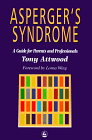
Asperger's
Syndrome: A Guide for Parents and Professionals by Tony Attwood and Lorna Wing.
(1997) An
easy-to-read book about Asperger's Syndrome for parents, educators, clinicians.
Covers the major characteristics and how to understand people who have of Aspergers.
One parent writes:
"I didn't realize how much I could depend on a book! It's like an instruction
manual for children with Asperger's Syndrome. I will pass it on to each of my
son's teachers every year . . .Thank you, Tony Attwood!" A
child psychiatrist wrote: The degree of humanism and respect for people with this
syndrome, and emphasis on their strengths and possible futures and careers is
outstanding."
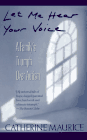 Let
Me Hear Your Voice: A Family's Triumph Over Autism Let
Me Hear Your Voice: A Family's Triumph Over Autism
by Catherine Maurice.
"In Let
Me Hear Your Voice: A Family's Triumph Over Autism, the process of recovery
is a sort of miracle, but documented, witnessed.
One that can be duplicated. One
that offers hope, not to all, but to some. And that is the best miracle of all."
- The Women's Review of Books
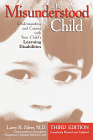
The
Misunderstood Child: A Parent's Guide to Understanding and Coping with Your Child's
Disabilities (Time Books, August 1998) This
book is on our "must-read" list for parents and professionals. Includes
excellent information about psychological, emotional, and social development;
up-to-date information about evaluations; and effective treatment strategies to
use at home and at school.
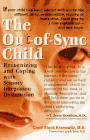
The
Out-of-Sync Child: Recognizing and Coping with Sensory Integration Dysfunction
by Carol Kranowitz. This
book describes the often conflicting symptoms of children with SI dysfunction.
You learn that these children can be diagnosed at an early age and receive OT
therapy when it is most effective. You learn many simple things that parents and
teachers can do at home and in the classroom to improve the functioning of SI
kids.
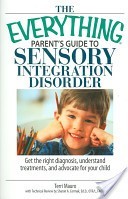 The Everything Parent's Guide To Sensory Integration Disorder by Terri Mauro. The Everything Parent's Guide To Sensory Integration Disorder by Terri Mauro.
Get the Right Diagnosis, Understand Treatments, And Advocate for Your Child.
In this parent guide you'll find the answers you need as you search for ways to help your child. This reassuring handbook examines various forms of treatment and therapy, and provides professional advice for helping children with SID succeed in school, at home, and with friends.
The Challenging Child: Understanding, Raising and Enjoying the Five "Difficult"
Types of Children by Stanley Greenspan and Jacqueline Salmon.
Identifies five
"difficult" child personality types--sensitive, withdrawn, defiant, inattentive,
and active/aggressive--explains development from the child's perspective -- offers
strategies to turn difficulties into positive personality traits.
 Maybe
You Know My Kid : A Parent's Guide to Identifying, Understanding, and Helping
Your Child With Attention Deficit Hyperactivity Disorder by Mary Cahill Fowler. Maybe
You Know My Kid : A Parent's Guide to Identifying, Understanding, and Helping
Your Child With Attention Deficit Hyperactivity Disorder by Mary Cahill Fowler.
Updated
edition of Mary Fowler's candid and dramatic guide for parents just like her,
whose children have Attention-deficit Hyperactivity Disorder . . . describes the
latest scientific advances and clinical breakthroughs and discusses the recent
changes in the education of children suffering from AD/HD. Examines the school's
role in assessing children, practical guidelines and suggestions for improving
educational performance. More
information.
|