|
|
|
Home > Topics > IDEA 2004 > 10 Tips: How to Use IDEA 2004 to Improve Your Child's Special Education by Wayne Steedman, Esq. |
|
|
Print
this page
Note:
Congress has reauthorized the Elementary and Secondary Education Act (ESEA), the statute formerly known as No Child Left Behind. The new statute, Every Student Succeeds Act, was signed into law by President Obama on December 10, 2015. 1.
Use the Findings and Purposes in IDEA 2004 to Establish
a Higher Standard for a Free, Appropriate Public Education (FAPE). In 1982,
the U. S. Supreme Court issued the first decision in a special education
case in Board
of Education v. Rowley, 458 U. S. 176. In Rowley,
the Court held that school districts did not have to provide the “best”
education for disabled students but merely had to provide services
so the child received “some educational benefit.” Rowley
established a low standard for a “free appropriate public education”
(FAPE). When
you read the Findings and Purposes of IDEA 2004, you will see that
Congress raised the bar for a free
appropriate public education (FAPE). Prepare
Children to Lead Productive, Independent Lives In “Findings”
of IDEA 2004 (Section 1400(c)), Congress found that “30 years
of research and experience has demonstrated that the education of
children with disabilities can be made more effective by having high
expectations for such children,” educating them in the regular
classroom so they can “meet developmental goals and, to the maximum
extent possible, the challenging expectations that have been established
for all children and be prepared to lead productive and independent
adult lives, to the maximum extent possible.” (Section 1400(c)(5)(A))
Prepare
Children for Employment, Independent Living – and Further Education In “Purposes”
of IDEA 2004 (Section 1400(d)), Congress describes what they intend
the law to accomplish. In IDEA 2004, Congress added “further
education” as a purpose of the law: “The
purposes of this title are to ensure that all children with disabilities
have available to them a free appropriate public education that
emphasizes special education and related services designed to
meet their unique needs and prepare them for further education,
employment and independent living.” (Section 1400(d)(1)(A)) When
you read in “Findings” that disabled children should be
given the opportunity to meet the “challenging expectations that
have been established for all children” and “improve academic
achievement and functional performance… to the maximum extent
possible” (Section 1400(c)(5)(E)) and you read that one Purpose
of the law is to prepare children for “further education,”
you are looking at a new legal standard for a free appropriate public
education. As a
parent or teacher, you need to understand that when Congress reauthorized
IDEA 2004, they raised the bar. To meet these new legal requirements
in IDEA 2004, schools will have to use research-based
instruction and provide more intensive special education services.
Meet
Developmental Goals & Challenging Expectations Established for
Nondisabled Children “to the Maximum Extent Possible” While
the phrase “to the maximum extent possible” was included
in earlier amendments to IDEA, there is significant qualitative difference
in how this phrase is used in IDEA 2004. In IDEA 1997, the phrase
“to the maximum extent possible” described the need to provide
disabled children with access to the general curriculum and prepare
children for life after school. In IDEA
2004, the phrase “to the maximum extent possible” describes
the requirements to meet the developmental goals and challenging expectations
established for nondisabled children, to prepare children with disabilities
to lead independent and productive adult lives, and to improve their
academic achievement and functional performance. Provide
Teachers with Knowledge & Skills in Scientifically Based Instructional
Practices Congress
also found that the education of children with disabilities can be
made more effective if all school personnel who work with children
with disabilities receive “high quality, intensive” professional
development and training to ensure that they have “the skills
and knowledge necessary to improve the academic achievement and functional
performance of children with disabilities, including the use of scientifically
based instructional practices, to the maximum extent possible.”
(Section 1400(c)(5)(E)) 2.
Use IDEA 2004 and No Child Left Behind (NCLB) to Obtain
a Better Individualized Education Program (IEP). Note:
Congress has reauthorized the Elementary and Secondary
Education Act (ESEA), the statute formerly known as No Child Left
Behind. The new statute, Every Student Succeeds Act, was signed into law by President Obama on December 10, 2015. When
Congress reauthorized IDEA 2004, they specifically noted the intent
to coordinate IDEA 2004 with the No
Child Left Behind Act. (Section 1400(c)(5)(C)) Many definitions
in IDEA 2004 come directly from NCLB, including the requirements for
highly qualified teachers. A highly
qualified teacher has full State certification (no waivers), holds
a license to teach, and meets the State’s requirements. Special
educators who teach core academic subjects must meet the highly qualified
teacher requirements in NCLB and must demonstrate competence in the
academic subjects they teach. (Section 1401(10)) Closing
the Gap The purpose
of the No Child
Left Behind Act is “to ensure that all children have a fair,
equal, and significant opportunity to obtain a high quality education
and reach, at a minimum, proficiency on challenging State academic
achievement standards and State academic assessments.” (20 U.S.C.
6301) IDEA
2004 requires states to establish performance goals for children with
disabilities that are the same as the state’s definition of adequate
yearly progress under NCLB. (Section §1412(a)(15)) Attacking
Low Expectations Congress
also found that implementation of the IDEA “has been impeded
by low expectations and an insufficient focus on applying replicable
research and proven methods of teaching and learning for children
with disabilities.” (Section 1400(c)(5)) School
personnel often assert that it is unreasonable to expect a child to
achieve more than one year of academic progress in one year. School
personnel assert this even more vigorously when they develop IEP goals
for disabled children, goals that often reflect their low expectations.
But if
a disabled child is two, three, or more academic years behind his
nondisabled peers, the only way to “close the gap” is for
the disabled child to make more than one year of academic progress
in one year. When children with disabilities receive intensive instruction
from teachers who are skilled in the use of scientifically based instruction,
it is not unusual for these children to make more than one year of
progress in an academic year. Parents
and teachers must learn about the requirements of NCLB and IDEA 2004
to ensure that these legal requirements are met. Although there is
no private right of action under NCLB (i.e., parents cannot sue schools
when they fail to meet NCLB’s requirements), the failure to meet
NCLB requirements can be used as evidence that a child did not receive
an appropriate education. (To learn more about No Child Left Behind
and IDEA, see Wrightslaw:
No Child Left Behind by Peter W. D. Wright, Pamela Darr Wright
and Suzanne Whitney Heath, published by Harbor House Law Press.) (Out of Print) 3.
Include Research Based Methodology in the IEP.
Congress
found that implementation of IDEA “has been impeded by the failure
of schools to apply replicable research on proven methods of teaching
and learning.” IDEA 2004 includes numerous references to “scientifically
based instructional practices” and “research
based interventions.” In describing permissible uses of federal
funds, IDEA 2004 includes “providing professional development
to special and regular education teachers who teach children with
disabilities based on scientifically based research to improve educational
instruction.” (Section 1411(e)(2)(C)(xi)) The child’s
IEP must include “a statement of the special education and related
services and supplementary aids and services, based on peer-reviewed
research to the extent practicable to be provided to the child.”
(Section 1414(d)(1)(A)(i)(IV)) In determining
whether a child has a specific learning disability, IDEA 2004 describes
a process by which the IEP team “may use a process that determines
if the child responds to scientific, research based intervention as
a part of the evaluation process.” (Section §1414(b)(6)(B))
This
language in IDEA 2004 creates new requirements for schools to use
scientific research based instructional practices and interventions
that are based on accepted, peer-reviewed research, if such research
exists. School
officials often refuse to write educational methodologies into the
IEP. They argue that teachers should be free to use an “eclectic
approach” to educating children with disabilities, and should
not be forced to use any specific methodology. Congress
rejected this practice when they reauthorized IDEA 2004. By including
frequent references to the need to use scientific, research based
instruction and interventions, Congress clarified that methodology
is vitally important. By requiring the child’s IEP to include
“a statement of special education, related services and supplementary
aids and services, based on peer reviewed research …” (Section
1414(d)(1)(A)) Congress clarified that IEPs must include research-based
methodology. Including
methodology in the child’s IEP will benefit the child’s
parents and teachers. As participants in developing their child’s
IEP, parents will benefit by having input into the instructional methods
used to teach their children. The teachers who implement the IEP will
benefit by having guidance from a team of professionals who are familiar
with the child and who have reviewed the research to determine the
interventions and instructional methods that are most likely to provide
the child with educational benefit. This
is a win, win situation for all – especially for children who
will benefit when they receive effective instruction from teachers
who are trained in research-based instructional methods. 4.
Ensure That Annual Goals are Comprehensive, Specific and Measurable.
IDEA
2004 eliminated short-term objectives and benchmarks for students
with disabilities, except for those students who take alternate assessments.
(Section 1414(d)(1)(A)(i)(I)) Short
Term Objectives The problem
is reminiscent of the game “Whack a Mole” where one knocks
one mole down, only to have another mole appear in a different location.
Since Congress eliminated short-term objectives and benchmarks, this
information will now have to be included in the annual goals. Eliminating
short-term objectives creates as many problems for educators as it
does for parents. Short-term objectives and benchmarks are steps that
measure the child’s progress toward the annual goals in the IEP.
When written correctly, short-term objectives provide teachers with
a roadmap and a clear mechanism to evaluate the child’s progress.
Academic
and Functional Goals Although
short-term objectives and benchmarks were eliminated, under IDEA 2004
the IEP must include “measurable annual goals, including academic
and functional goals.” (Section 1414(d)(1)(A)) IEP goals cannot
be broad statements of what a child will accomplish in a year, but
must now address the child’s academic achievement and functional
performance. The IEP must specifically identify all the child’s
needs, how the school will meet these needs, and how the school will
measure the child’s progress objectively. If the
IEP goals are not specific and measurable and do not include academic
and functional goals, the IEP is defective and open to a challenge
that it denies the child a FAPE. Parents
must be vigilant. The danger is that the IEP team will propose annual
goals that are not specific and measurable, do not meet the child’s
academic and functional needs, and do not describe how the child’s
progress will be measured. Teachers
will have to work harder and think more creatively to ensure that
the annual goals address all the child’s educational needs and
that the goals are written in clear, measurable language. If the IEP
is based on the child’s “present levels of academic achievement
and related developmental needs,” addresses the child’s
academic and functional needs, and includes research validated instructional
methods, the IEP should adequately address the child’s needs
under IDEA 2004. 5.
Use New Evaluation Procedures to Monitor Academic
Progress and Progress on IEP Goals. IDEA
2004 expanded the range of educational issues that must be evaluated
and the timeframe within which these evaluations must be completed.
After the parent provides consent, the school must complete the initial
evaluation and determine if the child is eligible for special education
services within 60 days. (Section 1414(a)(1)) Interestingly, the Act
does not specify whether the required consent must be in writing.
When
conducting an evaluation, the school shall use “a variety of
assessment tools to gather relevant functional, developmental, and
academic information, including information provided by the parents.
(Section 1414(b)(2)) The child’s academic achievement or functional
performance may necessitate a reevaluation. (Section 1414(a)(2)) These
references to measuring and improving the child’s academic achievement
and functional performance are new in IDEA 2004. The IEP team must
now consider functional, developmental and academic information in
developing an IEP that provides a child with a free appropriate public
education (FAPE). School
personnel often claim that grades and performance on IEP goals are
separate, and that academic failure does not mean that the child was
denied a FAPE. IDEA 2004 rejects this claim. To meet
the threshold requirements for a FAPE, the school must ensure that
the child with a disability makes adequate progress in academic achievement
and functional performance, and on the IEP goals. If the child’s
academic achievement and functional performance are not commensurate
with the child’s progress on IEP goals, the child’s IEP
needs to be revised. The parents and educators need to determine what
adjustments need to be made to the child’s special education
program and IEP. IDEA
2004 requires the school to obtain parental consent before the initial
evaluation and before implementing special education services in the
IEP. Although the wording of the statute changed in IDEA 2004, the
substantive effect is no different for initial evaluations. Parental
Consent for the Initial Evaluation Before
conducting an initial evaluation (the first assessments requested
by a school when a child is suspected of having a disability), the
school must obtain parental consent. (Section 1414(a)) If the parent
wants the child to receive special education services, there is no
reason for the parent to deny consent for the initial evaluation unless
the parent prefers to obtain evaluations from a specialist in the
private sector. In that case, the parent may consent to the school
doing some evaluations. For example, the parent may consent to the
school conducting educational evaluations and have their independent
psychologist conduct the psychological evaluation. While
IDEA 2004 requires IEP teams to review evaluations provided by the
parent, the team is not required to accept the findings and recommendations
in private evaluations. Private evaluations can lead to problems if
they are improperly done or if the individual who conducts the evaluation
does not meet state requirements. (Section 1414(b)(3)) Before
scheduling an evaluation by an expert in the private sector (i.e.
a child psychologist, school psychologist, neuropsychologist, or educational
diagnostician), the parent should carefully review the individual’s
credentials. Here are some questions you need to answer: Parental
Consent for Special Education & Related Services The parent
is also required to give consent for special education and related
services. If the parent refuses to provide consent for services, the
public school “shall not provide special education and related
services to the child…” (Section 1414(a)(1)(D)(ii)(II))
This language represents is a significant change from IDEA 1997 which
required schools to seek mediation or due process to obtain parental
consent for services. This
new language may create problems for parents who want their child
to receive special education and related services, but disagree with
part of the IEP and/or how the school plans to provide services in
the IEP. The law does not prevent parents from consenting to parts
of the IEP that are acceptable, while refusing consent for those parts
of the IEP with which they disagree. There is some support for this
approach in the IDEA 2004 statute. IDEA
2004 maintains the “stay put” provisions of IDEA 1997. (Section
1415(j)) Under the “stay put” provision, the child can remain
in the then-current educational placement and continue to receive
the same services during proceedings to challenge the IEP, unless
the parents and school agree otherwise. Although there is no “then-current
educational placement” when there is a dispute between parent
and school over the initial IEP, the fact that the parent and school
agree on some part of the IEP creates an obligation for the school
to implement those parts of the IEP to which the parent provided consent.
If you
want to consent to part of the IEP, here are some suggestions: Congress
changed IDEA 2004 to allow members of the IEP team to be excused from
attending IEP meetings, even when their area of the curriculum or
related service will be discussed. As a parent, you do not have to
consent to this. Before a team member can be excused, the individual
must submit a written report to the IEP team and the parent must consent
in writing. (Section 1414(d)(1)(C)) The demands
placed on a teacher’s time are great. In the end, the time spent
developing a comprehensive IEP that addresses the child’s unique
needs will save time. More important, input from all the child’s
teachers will benefit the child. Regardless of whether the parent
consents to a regular education teacher being excused from an IEP
meeting, the law still requires that at least one regular education
teacher attend the meeting. If the
child receives any educational services in a regular education class
or may receive educational services in a regular education class,
the regular education teacher(s) should attend the IEP meeting. Although
the law only requires one teacher to attend, all regular education
teachers with whom the child has or will have contact should attend
the IEP meetings. If the child’s teachers do not attend an IEP
meeting, it is likely that important information will be missed or
overlooked. Without input from the child’s teachers, other members
of the IEP team, including the receiving teachers, will not understand
the child’s unique needs and how to address these needs. The parent
should not consent to team members being excused from IEP meetings
unless the circumstances are exceptional. If a team member’s
area will be discussed, the teacher or related services provider needs
to attend the meeting to provide information and answer any questions
that arise. 8.
Avoid Three-Year IEPs Like the Plague. The three-year
IEP was the dumbest idea Congress came up with when they reauthorized
IDEA 2004. Determining a child’s unique academic, developmental
and functional needs, developing measurable annual goals, determining
how these goals will be met, how the child’s progress will be
measured, and how the parents will be advised of their child’s
progress at regular intervals is difficult enough when only done once
a year. Anyone
who thinks that parents and school personnel can develop an IEP that
will meet a disabled child’s needs for three years is ignorant
about child development and education. Fortunately, three year IEPs
are a pilot program that will be available in no more than 15 states.
(Section 1414(d)(5)) If your state submits a proposal and is approved
for the three year IEP pilot program, the IEP team must obtain your
consent before they develop a three-year IEP. Do not grant consent. Find
out if your state was approved for the IEP pilot program. If your
state was approved for the pilot program, you need to double-check
the beginning and ending dates on any IEP for your child. Before you
sign consent to implement your child’s IEP, make sure the IEP
has an ending date that is no longer than twelve months after the
IEP was developed. You are
not limited to one IEP meeting a year. Parents and teachers can request
an IEP meeting to review and revise the child’s IEP more often
than once a year. IDEA 2004 provides that the IEP team shall revise
the IEP to address: 9.
Challenge Suspension or Expulsion if Child’s
Behavior was a Manifestation of the Disability, or if the Alternate
Placement Does Not Provide FAPE. IDEA
2004 permits the school to suspend a disabled child from the current
program or place the child into an interim program for up to 10
days if the child violates a “code of student conduct.”
(Section 1415(k)(1)(A)) If the
school wants to suspend the child for longer than 10 days,
they must convene an IEP meeting to determine whether the child’s
behavior is a manifestation of the child’s disability. If the
school concludes that the child’s behavior was not a manifestation
of the disability, the school can discipline the child in the same
way and to the same extent that a nondisabled student can be disciplined.
(Section 1415(k)(1)(C)) Congress
also made it easier for the school to determine that the child’s
behavior is not a manifestation by eliminating key elements of the
manifestation determination process in IDEA 1997. IDEA 2004 does not
require the IEP team to determine whether the child’s IEP and
placement are appropriate. IDEA 2004 only requires the IEP team to
determine whether the child’s behavior “was caused by or
had a direct and substantial relationship to the child’s disability”
or ” whether the behavior was the “direct result of the
local education agency’s failure to implement the IEP.”
(Section 1415(k)(1)(E)) This
means the school could provide a child with an inappropriate special
education program and placement, and could expel the child from school.
There are several strategies you can use to ensure that the school
does not use behavior problems as a way to deprive your child of an
appropriate education. IDEA
2004 still requires school districts to provide a free appropriate
public education to all children with disabilities, including children
who have been suspended or expelled from school. (Section 1414(k)(1)(D)
and Section 1412(a)(1)) If the
school places your child into an alternate setting, you must diligently
investigate whether or not the child’s IEP is being fully implemented.
If the IEP is not being implemented, you may force its implementation
through the dispute resolution procedures in the law. One strategy
is to challenge the IEP team’s determination that the behavior
was not a manifestation of the child’s disability. Parents must
only request a due process hearing if they are prepared and have a
valid claim. (See Tip #10). If you
attempt to argue that the IEP and/or placement were not appropriate
as the reason for the behavior being a manifestation, you may be met
by a claim from the school district that your action was frivolous.
Parents can certainly argue that the IEP and/or placement are not
appropriate. You should also include claims that the behavior for
which the child is being disciplined was caused by or had a direct
and substantial relationship to the child’s disability, and/or
that the child’s misbehavior was the direct result of the school’s
failure to implement the IEP, if these claims are valid and you have
support for them. 10.
Avoid Due Process Hearings if Possible.
Due process
hearings should be your last resort, after you have attempted all
other methods to resolve your dispute. Due process hearings are often
an expensive and lengthy process. There are few absolutes in the law,
and perhaps even fewer absolutes in the context of special education
litigation. Try to
resolve your dispute through IEP meetings, mediation, and/or the Resolution
Session before you request a due process hearing. Mediation Parents
and schools can attempt to resolve their dispute through mediation.
Mediation is a confidential process that allows parties to resolve
disputes without litigation. The mediator helps the parties express
their views and positions and understand the other’s view and
positions. Before entering into mediation, you need to understand
your rights and the law. When you mediate, your goals are to resolve
the problems and protect the parent-school relationship. If the
dispute is resolved in mediation, IDEA 2004 requires the parties to
execute a legally binding agreement that sets forth the terms of the
resolution. (Section 1415(e)(2)(F)) Resolution
Session IDEA
2004 includes a new mandatory “resolution session” that
provides the parties with an opportunity to resolve their dispute
before the due process hearing. (Section 1415(f)(1)(B)) The school
district must send “the relevant member or members of the IEP
team” who have knowledge about the facts in the parents’
complaint and a school district representative who has decision-making
authority. The school board attorney may not attend the Resolution
Session unless an attorney accompanies the parent. The parents and
school district may waive the Resolution Session or use the mediation
process. If the school district has not resolved the complaint to
the parents’ satisfaction within 30 days of receiving the complaint,
the due process hearing can be held. (Section 1415(f)(1)(B)(ii)) Due
Process Hearings If your
attempts to resolve your dispute have been unsuccessful, you may decide
to request a due process hearing. Consult with an attorney who is
knowledgeable about this area of law first. Many of the pretrial procedures
and timelines for due process hearings are new in IDEA 2004. These
pretrial procedures are technical and cumbersome. IDEA
2004 includes other disincentives for parents who file for due process.
If the parents’ claim is found to be “frivolous, unreasonable,
or without foundation,” the parents’ attorney can be held
liable for the school district’s attorney’s fees. (Section
1415(i)(3)(B)) If the parents’ complaint was filed “for
any improper purpose, such as to harass, to cause unnecessary delay,
or to needlessly increase the cost of litigation,” the parents
can be held liable for the school district’s attorney’s
fees. Congress
only envisioned shifting the school district’s attorney’s
fees to parents or their attorneys in extraordinary cases. This fee
shifting statutory language closely follows Rule 11 of the Federal
Rules of Civil Procedure and a case from the U. S. Supreme Court (Christiansburg
Garment Co. v. EEOC, 434 U.S. 412 (1978)). Cases in which a plaintiff
is forced to pay a defendant’s attorneys under Rule 11 or the
Christiansburg standard are rare. (See IDEA
2004: Rule 11 and Attorneys Fees by Pete Wright) Parents
should not be deterred from requesting a due process hearing out of
fear that they may have to pay the school’s attorney’s fees,
if they are filing in good faith and have a valid claim. You should
avoid a due process hearing if possible. The best way to avoid a due
process hearing is to prepare for a due process hearing as soon as
you realize that you have a disagreement or dispute with the school
about your child’s special education program. If you
have a well-organized case and a clear, simple theme, you will be
in a stronger position if you need to request a due process hearing.
IDEA
2004 at Wrightslaw will help you find answers to your questions.
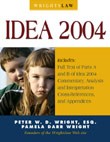
How the site is currently organized: Wrightslaw: Special Education Law, 2nd Edition Formats How to Order Discounts The E-book Synopsis Table of Contents About the Authors Early Reviews Wrightslaw:
IDEA 2004 (Out of Print) Wrightslaw:
IDEA 2004 is available as a print book, an
e-book - or both. Print
publication (168 pages, 8 1/2" x 11", perfect
bound, $14.95). Wayne Steedman is a partner at The Steedman Law Group. His practice is devoted primarily to the
representation of children with disabilities. He has represented his
clients in administrative due process hearings and state and federal
courts. Learn
more about Wrightslaw
training programs. Contact
Info
Wayne D. Steedman, Esq. Last updated: 03/12/19
Copyright © 1998-2026, Peter W. D. Wright and Pamela Darr
Wright. All rights reserved.
Contact Us |
Press l Mission l Our Awards l
Privacy
Policy l
Disclaimer l
Site Map |
||||||||||||||||||||||||||||||


 Wrightslaw: Special Education Law, 2nd Edition