"I think my child has a learning disability - what tests
should I request?"
"My child has Down Syndrome - what tests should I request?"
I am an advocate, not a psychologist, so I do not advise parents
to ask their
evaluator to use specific tests.
You want to select an evaluator
who is knowledgeable about your child's disability. Your evaluator
should have expertise and knowledge about a variety of tests and
should use this expertise to select appropriate tests for your
child. (Read How
Can I Find an Evaluator or Educational Consultant)
Parents do need to provide their evaluator with proper information
about the child - this information will help the evaluator decide
which tests to administer. At a minimum, you should provide your
evaluator with all previous testing and evaluations. Ask the evaluator
what additional information s/he needs.
Learning About Evaluations
To learn about evaluations, read these articles
about evaluations.
If you have Wrightslaw:
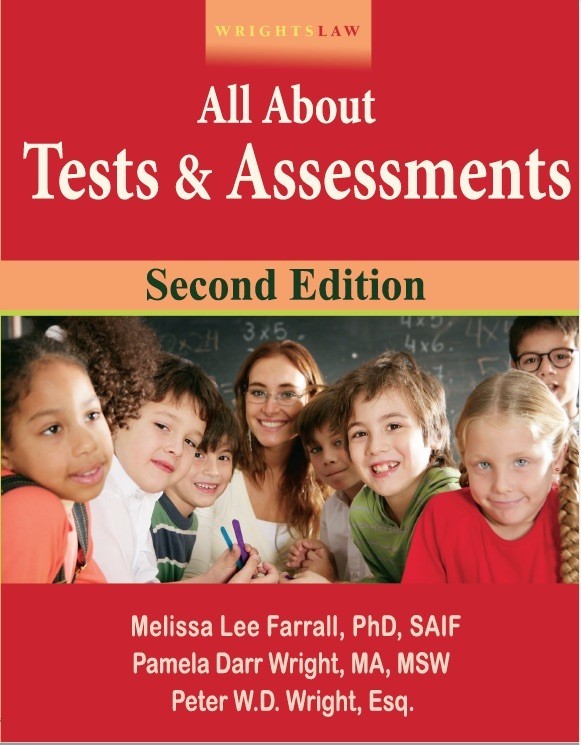
From Emotions to Advocacy, 2nd edition (FETA-2), the new
book by Pete and Pam Wright, you should read Chapter 10, Tests
and Measurements 101, and Chapter 11, Tests and Measurements 102.
The second edition was revised to include information
about tests used to assess children and the strengths and weaknesses
of these tests, including:
Reading Tests: What different
reading tests measure and do not measure
Wechsler Intelligence Scale for Children,
Fourth Edition (WISC-IV): Index and Subtest Scores;
key differences between the WISC-III and WISC-IV
Other Measures of Intellectual Functioning:
Differential Ability Scales, Stanford-Binet, Woodcock Johnson,
etc
Comprehensive Educational Achievement
Tests: Kaufmann, WIAT, Peabody, Woodcock Johnson-IV,
Single Subject Tests: Gray
Oral Reading Test, Woodcock Johnson IV Diagnostic Reading Battery,
Comprehensive Test of Phonological Processing, Test of Written
Language, KeyMath, more
Personality Tests and Behavior Rating
Scales
Speech
and Language tests and Vocabulary Tests
Learn How to Use Tests to Measure Progress
This
is not to say that you should not learn about tests in general.
You need to know the difference between criterion-referenced
and norm-referenced tests. You need to know that test instruments
must have high
validity and high reliability. The validity of a test depends
on whether the sample used to determine the norms for that test
was made up of individuals who are similar to those for whom the
test will be used.
Parents and advocates need to know how to use
the Bell Curve to interpret the child's test results. You
can learn about these topics by reading Measuring
Progress: Tests & Measurements for the Parent, Teacher, Advocate
and Attorney or Chapters 10 and 11 on Tests and Measurements
in Wrightslaw:
From Emotions to Advocacy, 2nd Edition)
Know
Your State's Rules & Laws About Testing
As a parent or advocate, you need to know your state's rules and
laws about the requirements for testing children with special
educational needs. If you do not understand these rules, the school
may reject the independent evaluation that you, the parent, paid
good money to obtain. It is just as important that you understand
your state requirements as it is for you to understand the tests
selected and the purposes for which these tests are used.
Let
me give you an example. Indiana requires that children who are
tested to determine
if they are eligible for special education due to a specific learning
disability be tested in at least the following areas:
1. Ability testing, i.e., IQ
2. Achievement testing i.e., educational needs
3. Additional measures of achievement for identified areas of
deficit identified by the first two areas of testing
4. Classroom observation
511
I.A.C. 7-26-8 (b) (1), (2), and (3)
Note: Please refer to 511 I.A.C. 7-26-8 (b) for other requirements.
As an advocate, I must advise parents that their independent evaluator
is also required to assess all these areas. The last thing an
advocate wants is to have the parents' expensive independent testing
thrown out because it did not meet all the components required
by law - especially when the parent relied on the advocate's advice.
For a student who is suspected of having some degree of mental
retardation, I must advise the parent that Indiana law does not
require a classroom observation for this disability category.
Despite this, I strongly recommend that the parent request a classroom
observation because this can provide valuable information about
how the child learns and performs in the classroom environment.
Indiana requires at a minimum, the following tests for a child
who is suspected of having mental retardation:
1. Ability testing, i.e., IQ
2. Achievement test, i.e., educational needs
3. Adaptive Behavior assessment
511
I.A.C. 7-26-9 (b) (1), (2), and (3).
Note: Please refer to 511 I.A.C. 7-26-9 (b) for other requirements.
Advice from an Advocate: Responsibilities,
Duties and Knowledge
If an advocate accepts the responsibility of representing to parents
what types of tests are required, the advocate also assumes the
duty to ensure that the parent understands all the legal requirements
under state law.
If you select an independent evaluator who is knowledgeable about
your child's disability and you trust the evaluator, you need
to have confidence that the evaluator will determine and use appropriate
tests for your child.
However, you should not assume that your independent
evaluator is knowledgeable about all the legal requirements about
testing in your state law.
An advocate should also know which independent evaluators are
reputable and which evaluators are on the school's referral list.
Being in a position to provide parents with this specialized information
is part of
what makes the advocate such an important resource for parents
of special needs children.
Copyright © 2005-6 by Pat Howey.
Related Articles
What
to Expect from an Evaluation. In this excellent article, psychologist
and literacy researcher Marianne Meyer walks you through the process
of gathering information and participating in the evaluation process.
What You Should Know About Evaluations. As
a parent, you must make sure that all areas of possible need are
assessed as quickly as possible. While some parents would rather
not allow their school system to evaluate their child, a refusal
to cooperate at this stage of the process can backfire . . . "
Read
article
Independent
Educational Evaluations (IEEs): What? How? Why? Who Pays?
Parent attorney Wayne Steedman describes
IEEs, the value of IEEs for parents and school personnel,
what the law requires, and who is financially responsible.
Independent
Educational Evaluations (IEEs):
Must Parents Chose an Evaluator from School's Approved List?
In 2004, the Office of Special Education Programs (OSEP) published
a Policy Letter about IEEs and parent choice; clarified that parents
have a right to choose their independent evaluator.
Tests,
Testing Issues and Advocacy. Dr. Bill Matthew, Director of
Special Education, Delano, CA, offers suggestions about tests
and and testing issues, including age & grade equivalents,
subtest scatter, improper use of projective tests, and tests that
are psychometrically sound.
Meet Pat Howey  Patricia Howey has supported families of children with disabilities since 1985. She has a specific learning disability and became involved in special education when her youngest child entered kindergarten. Pat has children, grandchildren, and great-grandchildren who have a variety of disabilities and she has used her experience to advocate for better special education services for several of them.
Pat is a charter member of the Council of Parent Attorneys and Advocates (COPAA), serving on its Board of Directors from 2000 through 2003. She has been a Commissioner on the Tippecanoe (County) Human Relations Committee, a graduate of Leadership Lafayette and Partners in Policymaking, and a member of the Wrightslaw Speakers Bureau. She has been on the faculty of the College of William and Mary Law School’s Institute of Special Education Advocacy since its inception in 2011.
Pat has an A.S. and a B.A. in Paralegal Studies from Saint Mary-of-the-Woods College, where she graduated magna cum laude. She is an Indiana Registered Paralegal and an affiliate member of the Indiana Bar and the American Bar Associations.
Pat began her advocacy career as a volunteer for the Task Force on Education for the Handicapped (now InSource), Indiana’s Parent Training and Information Center. In 1990, she opened her advocacy practice and served families throughout Indiana by representing them at IEP meetings, mediation, and due process hearings.
In 2017, Pat closed her advocacy practice and began working on a contract basis as a special education paralegal. Attorneys in Indiana, Texas, and California contracted with her to review documents, spot issues, draft due process complaints, prepare for hearings, and assist at hearings. In January 2019, she became an employee of the Connell Michael Kerr law firm, owned by Erin Connell, Catherine Michael, and Sonja Kerr. Her duties have now expanded to assisting with federal court cases.
"Changing
the World -- One Child at at Time."
Contact Information
Patricia L. Howey, B.A., IRP
POB 117
West Point, Indiana 47992-0117
E-mail: specialedconsulting@gmail.com
Webpage: https://cmklawfirm.com/
Revised 07/20/19
To
Top