|
|
Print this page
What is Your Bell Curve IQ?
by Peter Wright, Esq.
Bell Curve IQ Test
Answers
Wrightslaw Game Plan
More Wrightslaw Quizzes
"Knowing how to use the bell curve is more important than knowing the law." - Pete Wright
To be a successful advocate, you must learn about tests and measurements.
You need to learn how to use the bell curve to measure your child's progress or lack of progress (regression).
As you learn how to use the bell curve, you will learn about standard scores, percentile ranks, and standard deviations.
The principles of tests and measurements are not difficult to learn. You use statistics in many areas of your life. When you read articles about social and economic change, politics or the weather, you are reading about statistics.
The biggest obstacle to learning is likely to be your personal fears and insecurities. Some parents believe they cannot understand test results. If you believe you cannot understand tests, it is time to change your beliefs!
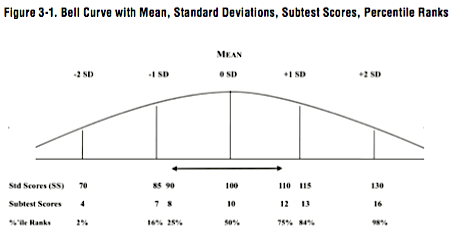
In our Special Education Law and Advocacy programs, we give each participant a pre-test quiz and a post-test exam to measure what they learned during our program. As part of the exam, each person draws the bell curve freehand and labels the vertical lines that represent standard deviations, percentile ranks and standard scores. Each participant will answer questions about standard scores and percentile ranks.
You may not be surprised to learn that before the program, very few people know how to do this. A few hours later, at the end of the program, more than 75 percent of participants have excellent scores on the bell curve.
Now it's your turn. Can you answer these questions correctly?
Bell Curve IQ Test
Two years ago, Johnny had a standard score of 85 on the Woodcock Reading Mastery test. His percentile rank was _____.
On recent testing, his standard score was 70, which is a percentile rank of _______. His standard
deviation on that test was _______.
On another test of reading skills, his oral reading rate was at the 16th percentile rank, which is the same as ______ deviations above / below (circle one) the mean.
On the Wechsler intelligence test, his IQ fell from 115 to 85, from the ______
percentile rank to the _______ percentile rank.
What percent of children have a standard score of between 85 and 115? _______.
Answers
To get the answers to this test, send a blank email to bellcurve@wrightslaw.com
Be sure to type BELL CURVE IQ in the subject line. You will receive an immediate autoresponse email with the correct answers to this Bell Curve IQ Test.
If you don't receive an email within a few seconds, check the email address to make sure you sent a blank email to bellcurve@wrightslaw.com
What was your score? If your score was 0, don't despair. You are in the same boat as most people who attend our training programs.
But, by the end of the program, most can draw the bell curve with the deviations, standard scores, and percentile ranks.
Your Wrightslaw Game Plan
This Wrightslaw Game Plan is designed to help you plug the gaps in your learning.
First, you need to study tests and measurements. There are three ways to approach this task.
1. Read the article, Tests
and Measurements for the Parent, Educator, Advocate and Attorney.
OR
2. Read Chapters 10 and 11 about Tests and Measurements in our book, Wrightslaw: From Emotion to Advocacy.

Tips:
- Read these chapters three times.
- Use a highlighter.
- Make margin notes.
- Do the homework assignments at the end of both chapters.
AND/OR
3. Download and use the 1.5 hour multimedia training program, Understanding Your Child's Test Scores.

In this program, Pete teaches you how to draw the bell curve and how to use your child's test scores to create powerful progress graphs. You'll also learn about standard scores, percentile ranks, subtest scores, composite or cluster scores, and subtest scatter.
After you use one or more of the methods described above, take the Bell Curve IQ test again. To get your answers, send a blank email to bellcurve@wrightslaw.com
What was your score this time? Were you surprised by your progress? Were you surprised to see how easy it can be to learn the bell curve?
If you are not satisfied with your score, read Chapters 10 and 11 about Tests and Measurements in Wrightslaw: From Emotions to Advocacyagain.
Review, Review, Retest
When you are learning new or unfamiliar information, you need to review and review again. If you have the multimedia program, you can review and replay the program to study the bell curve and graphs as often as you like.
Keep practicing until you get a perfect score!
After a training program, people who attended often send emails. Here are two that made our day:
"I went through my child's tests and pulled out tests that were administered more than once. I converted standard scores to percentile ranks, plotted the scores out on a graph, and brought these graphs to the next IEP meeting. The IEP team was stunned - and they agreed that my child needs a more intensive special education program. Thank you for making me learn the bell curve!" - Marie from Maryland
"I attended your program and want to share a story with you. In a meeting with our advocacy staff, I was asked to explain the discrepancy theory. Imagine my joy in being able to step up to the easel and draw a bell curve freehand (with standard deviations), then explain!" - Cindy from Tennessee
More Wrightslaw Quizzes
What's Your 504 IQ?
Vocabulary Quiz: Special Education Legal & Assessment Terms
Let's See What You Know About Effective Communication.
Law School Final Exam - Special Education Law & Advocacy
About the Authors
Pete and Pam Wright are the authors of Wrightslaw:
Special Education Law, 2nd Edition and Wrightslaw: From Emotions to Advocacy, 2nd Edition. The Wrights are co-founders of Wrightslaw and have published the free weekly newsletter, The Special Ed Advocateabout special education law and advocacy since 1998.
Pete and Pam Wright do training programs about special education law and advocacy. To see if they are coming to your area, please check their schedule page.
Revised: 01/12/22
| |